If you want to know things to do in Madrid because it’s your first time visiting, don’t miss this article. We’ll take a tour of the most emblematic places in the Spanish capital, such as Madrid de los Austrias and its museums, so you don’t miss a thing.
I spent over 10 years living in Madrid and it’s a city that welcomed me with open arms. I have a lot of affection for it and I wouldn’t want anyone to miss out on this city where I was so happy.
In this article I’ll include the most visited places in Madrid, or at least those I would personally recommend to anyone visiting for the first time, based on my travel experience. But there are many more places I love – parks, hidden corners, restaurants, hotels, and other recommendations – and even many places to see near the capital that you’ll also enjoy.
🔝 Plan your trip! Check out this article if you want to know things to do in Madrid in 3 days.
Map with the places to see in Madrid if it’s your first time
Here’s the map with the places I mention in this article. Obviously there are many more, but if you only have a couple of days in the city, make sure to visit these spots.
They are organized by colors, so when you visit one, you’ll find most of the others nearby. As you’ll see, it’s very easy to get around Madrid.
1) Puerta del Sol
What better way to start our visit to Madrid than at Kilometer Zero, located in Puerta del Sol! This landmark, which marks where the country’s main roads begin, is set in the ground in front of the Real Casa de Correos, a building that currently houses the Presidency of the Community of Madrid.
Apart from its renovated façade, you should take a look at the tower that rises above, with its clock and bells. Every New Year’s Eve, crowds gather in the square to celebrate the beginning of the year with 12 chimes, accompanied by 12 grapes and a toast.
At one end of Puerta del Sol stands one of the most beloved monuments among Madrileños: the Bear and the Strawberry Tree, a small tree with red fruits. Even though this image appears on all of the city’s coats of arms and flags, neither the tree nor the bear are typical of the area. Still, it has become one of the must-see spots in Madrid.
And since we’re in Puerta del Sol, let’s pay attention to other symbols and monuments here. First, note that there’s no actual “Gate” today, but apparently a few centuries ago there was, marking the entrance to the Villa de Madrid.
Now look up and you’ll see the Tío Pepe sign, an Andalusian wine brand, located at number 11 Puerta del Sol. It used to be at number 1, where the Apple Store is now. Both day and night, brightly lit, it’s one of the things you definitely have to see in Madrid.
In the center stands the equestrian statue of Charles III, and nearby you’ll find a glass structure that is the entrance to the Sol metro station.
💯 Don’t miss stopping at La Mallorquina Pastry Shop, a long-standing favorite on that Madrid corner. Try a chocolate palmier or a napolitana to taste the locals’ favorite pastries.

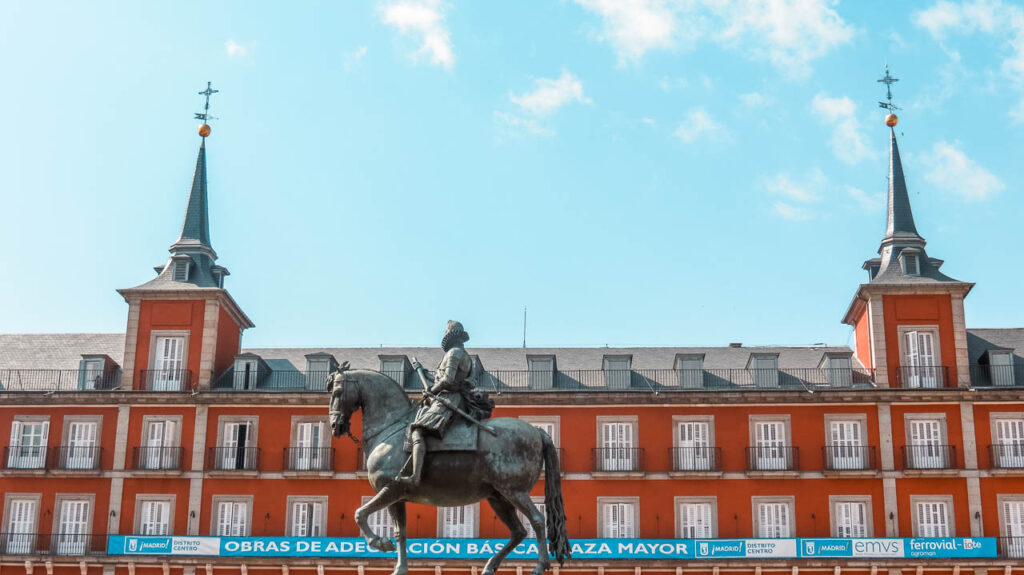
2) Plaza Mayor
This square is a true gem. Like most main squares in Spain, it’s rectangular due to the surrounding buildings, and you enter it through large arches.
What can you see in Plaza Mayor? The Casa de la Panadería, recognizable by its painted walls, opposite the Casa de la Carnicería, and in the center of the square stands the equestrian statue of Philip III. If you’re visiting Madrid in winter, you’ll find it filled with stalls and Christmas spirit.
If you want a different culinary experience and to enjoy many options in one place, you can’t miss the San Miguel Market. In the past, it was a market for fruit, vegetables, meat, and fresh produce.
Today it’s a spot where you can try traditional Spanish tapas and sandwiches with a drink. There are high tables with stools to sit at, the décor is carefully designed, and the atmosphere is great.
💯 Tip: If you want to enjoy a sandwich in Plaza Mayor without spending too much, a Madrid classic is the calamari sandwich shops.
3) Royal Palace of Madrid
One of the must-see places in Madrid is the Royal Palace of Madrid, which, although it is the official residence of the King of Spain, is now mainly used for ceremonies and other official events. The current royal family lives in the Palace of Zarzuela, on the outskirts of the city.
You should visit it not only for the beauty and luxury of its halls and rooms, but also for the stories it holds. It’s built on the site of a former Royal Alcázar (a defensive fortress destroyed by fire) and is one of the largest palaces in Western Europe.
✏️ Visiting the Royal Palace of Madrid: If you’re a citizen of the European Union or an Ibero-American country, you can enter for free from Monday to Thursday in the afternoon (4–6 pm in winter / 6–8 pm in summer). Entry is allowed up to one hour before closing, so don’t forget to bring your passport.
📷 Book your guided tour to the Royal Palace of Madrid here.

Around the area there are other places worth visiting:
- Campo del Moro: these are huge gardens located between the Palace and the Manzanares River. One of the most iconic views is the main promenade, which is set on a slope with the Palace in the background. Since it’s quite large, you’ll need some time to explore it.
- Sabatini Gardens: these gardens are on the north side of the Palace, heading toward Plaza España, on the left. There’s a double staircase leading down to them (open to the public), but you can also view them from above. You’ll see neatly trimmed hedges, paths, fountains, and a pond.
- Plaza de Oriente: before reaching the Sabatini Gardens, on the right-hand side, is Plaza de Oriente. Highlights include the monument to Philip IV, the Royal Theatre in the background, and about twenty limestone statues lining the square. These represent different Kings of Spain and were originally meant to decorate the top of the Royal Palace, but according to legend, a queen dreamed one would fall on her, so they were placed here instead.
- Royal Theatre: this is Madrid’s Opera House and one of the most elegant theaters in the country. It can be visited inside, and the theater offers different types of tours: general, technical, artistic, and more. Check it out on their website.
- Arab Wall: Madrid wasn’t immune to the Muslim rule that spread across the Iberian Peninsula from the 8th to the 15th century. This 10th-century wall may be one of the oldest structures in the city.

- Segovia Viaduct: south of the Royal Palace, Bailén Street crosses this bridge toward Las Vistillas, with Segovia Street running underneath—once the bed of a stream. It’s also known as the “Bridge of Suicides” because many used its height for that purpose, which is why you’ll now find it glassed in.
🔝 On the outskirts of Madrid, you can also visit the Royal Palace of El Pardo, another residence of the Spanish monarchs.
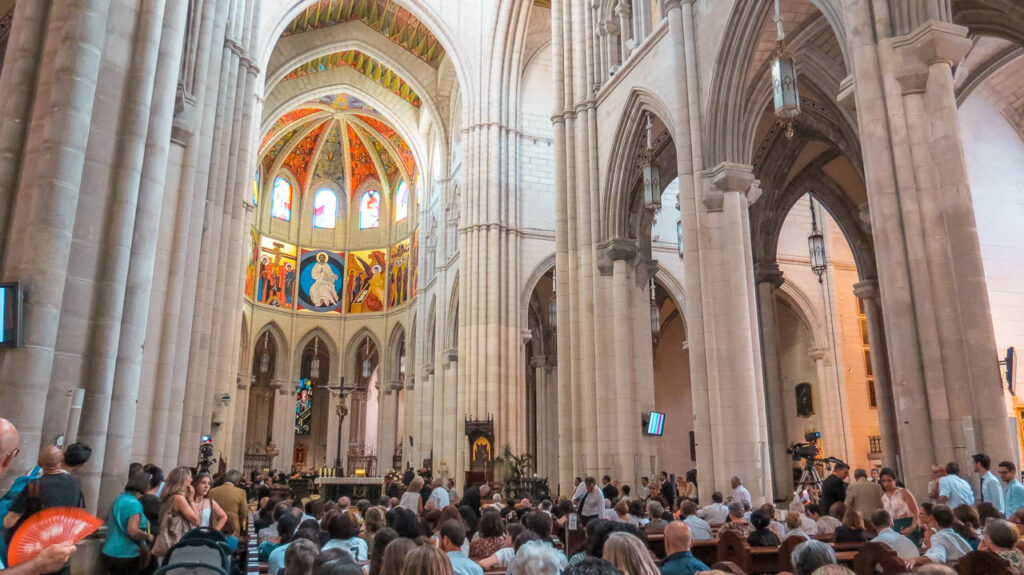
4) Almudena Cathedral
La Almudena is the patron saint of Madrid (her feast day is celebrated in the city on November 9), and this cathedral is dedicated to her. It is the only Spanish cathedral consecrated by a pope, John Paul II, during his fourth visit in 1993.
Although the main façade faces the Royal Palace, at Plaza de Armería, there’s also an entrance on Bailén Street, which is the one used to visit the inside. From the outside, many consider it rather plain, but inside it is stunning and impeccably maintained.
📷 Book here the guided tour of Almudena Cathedral and the Royal Palace.
5) Prado Museum
One of the most important museums in the world and one of the vertices of Madrid’s so-called “Art Triangle,” along with the Reina Sofía and Thyssen-Bornemisza, all located very close together to form this geometric figure.
It has a vast collection of 16th to 19th-century paintings by renowned artists such as Velázquez, El Greco, Titian, Goya, Rubens, Bosch, Murillo, and many more. Needless to say, visiting the museum will take several hours. Whether you’re passionate about classical art or not, you’ll likely spend at least 4 hours inside.
📷 Book here the guided tour of the Prado Museum. You can also combine the guided tour of the Prado and Reina Sofía museums from here.
✏️ To visit the Prado Museum, many people enter two hours before closing time when admission is free, but even then it’s not enough. First, because the line outside is extremely long, and by the time you get in, you’re almost out. Check all schedules and prices here. This is one museum where it’s truly worth paying the current €15 entrance fee (as of 2025).

6) Reina Sofía Museum
If the Prado Museum represents the classics, the Reina Sofía represents the modern, with many works of surrealism, cubism, and expressionism. It’s another must-see museum in Madrid that requires plenty of time.
Here you’ll find numerous works by Pablo Picasso, Salvador Dalí, and Joan Miró, among others, which are the main reason this is one of the most visited museums in Spain. The most sought-after piece among the millions of visitors each year is Guernica, Picasso’s powerful painting depicting the bombing of the Basque city during the Spanish Civil War.
📷 Book here the guided tour of the Reina Sofía Museum. You can also combine the guided tour of the Prado and Reina Sofía museums from here.
✏️ Just like the Prado Museum, the last two hours of the day (though not every day) and Sunday afternoons are free to visit the Reina Sofía Museum. You can check updated schedules here. If you prefer to enjoy this kind of art at your own pace, it may be worth paying the general admission, which is €12 as of 2025.

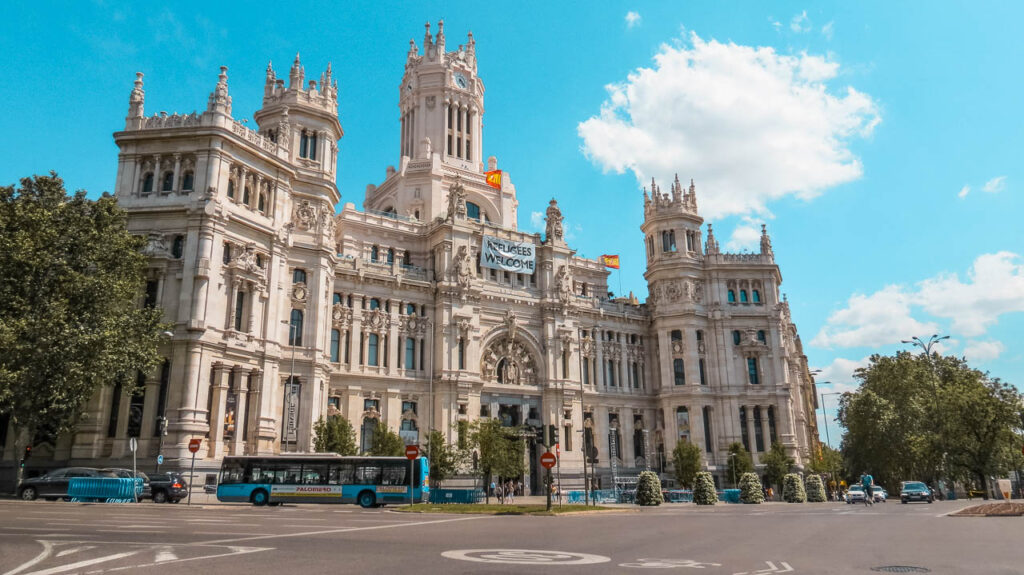
7) Cibeles Fountain
This fountain, a true symbol of Madrid, deserves a special mention. I was mesmerized the first time I saw it, surrounded by the Palace of Communications (now Madrid’s City Hall), the Bank of Spain, and the Casa de América. It also serves as a central hub connecting Calle de Alcalá (already a two-way avenue in this stretch), Paseo de Recoletos, and Paseo del Prado.
It is the meeting point for Real Madrid fans to celebrate when they win cups and championships. The players also usually parade on a bus, greeting fans and showing the trophy.
An interesting fact is that it originally started as the gathering spot for Atlético de Madrid fans, but later they moved their celebrations to the nearby Neptune Fountain, in front of the Prado Museum.
If you walk in the opposite direction of the Puerta de Alcalá, you’ll come across one of the most iconic avenues in Madrid, Gran Vía. It’s a major entertainment and shopping hub in the city. Here you’ll find top clothing brands and theaters with shows you’ll love.

8) Puerta de Alcalá
Whether because of Sabina or Ana Belén and Víctor Manuel, I’m sure, like me, you already dreamed of Puerta de Alcalá even before seeing it in person. It’s named this way because if you went through its gate to leave the city, the road would lead to nearby Alcalá de Henares.
It stands right in front of one of the entrances to Retiro Park, which in earlier times was outside the walled city and considered a royal retreat.
The gate is in neoclassical style and filled with beautiful details such as inscriptions, reliefs, coats of arms, and statues. The square where it’s located, a semi-roundabout (circular but you can’t make a full turn), is always decorated with well-kept, colorful plants and flowers. It’s one of my favorite spots and, for me, one of the must-see places in Madrid.

9) Retiro Park
Madrid isn’t particularly known for its greenery, at least not in the city center, so it’s a blessing to have Retiro Park, whether for strolling or exercising. When I lived there, I used to walk the nearly 5 kilometers around it every day with a friend. We would meet many people jogging or walking just like us.
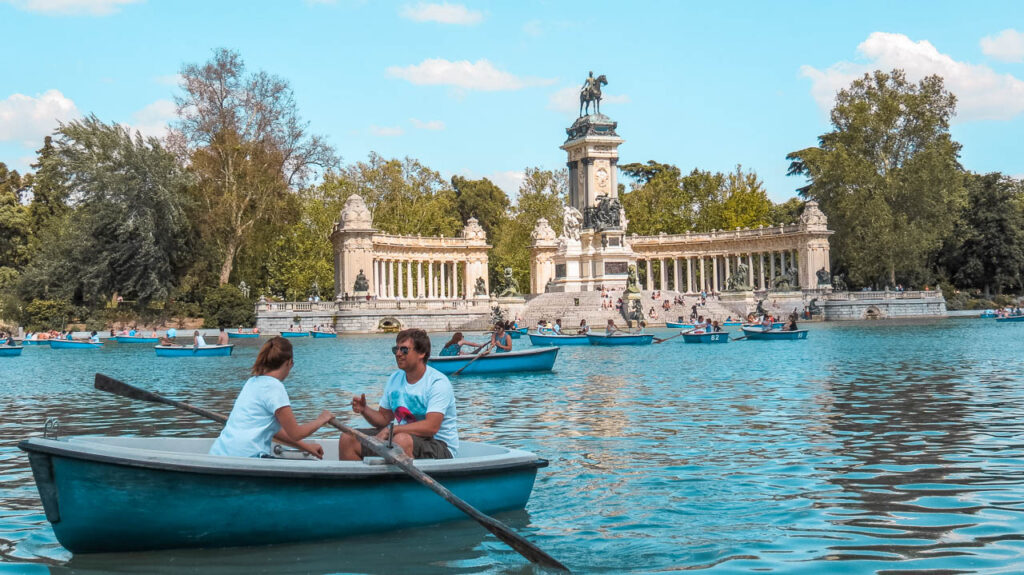
The busiest day at the park is usually Sunday, a day of rest when many gather around the central lake, whether to row the rental boats, listen to street musicians, or grab a drink at one of the snack and beverage stalls.
Besides beautiful fountains and ornamental monuments, there are some buildings inside Retiro Park that are worth visiting:
- Monument to Alfonso XII, a large white structure that decorates the lake.
- Casa de Vacas Cultural Center, which hosts temporary art exhibitions.
- Velázquez Palace, managed by the Reina Sofía Museum, with modern art collections.
- Crystal Palace, located by a small pond, which also hosts temporary modern art exhibits (also managed by the Reina Sofía Museum).
- Other smaller pavilions include the Fisherman’s House, the Smuggler’s House, and even a Medieval-style castle. Retiro is perfect for discovering these hidden treasures among the trees, plants, and flowers.
Right between Retiro and the Prado Museum lies the Royal Botanical Garden, perfect for flower, plant, and garden lovers from around the world. Highlights include very tall cacti and centuries-old trees. The general admission is €4 as of 2025 (free for those under 18 and other groups).

10) Santiago Bernabéu Stadium
It’s still uncertain what the future of this stadium will be, so while it’s still standing, make the most of it and visit. If you’re a football fan, you’ll love exploring its facilities, including the trophy exhibition rooms (plenty of Champions League cups there), locker rooms, and the pitch.
📷 Book here the tour to visit Real Madrid’s stadium.
If you’re not that into football and your trip to Madrid happens between July and August, when the players are on break, they usually open a viewing platform overlooking the stadium at the Real Madrid Café, where you can enjoy a drink or a beer while taking in the atmosphere.

Although I’ve only listed 10, I’ve actually mentioned quite a few more within each section. There are just so many things to do in Madrid! I still owe you more articles with recommendations.
Madrid is, without a doubt, one of the European cities I hold dearest, and I hope this article has passed on some of that enthusiasm to you.
Spring knows I’m waiting for her in Madrid.
Joaquín Sabina
Practical information for traveling to Madrid
The best way to see Madrid’s most iconic landmarks
Many of the places to see in the Spanish capital mentioned above can be visited on a tour — and what better way to do it than with one of the free walking tours in Madrid.
Whether you’re interested in the history of the Habsburgs, Madrid de las Letras, a stroll through the historic center, or even the mysteries that surround the city center, expert guides will tell you everything.
Getting around Madrid by Metro and Bus
Getting around Madrid by metro and bus is really fantastic. The network connects all the main sites without leaving anything uncovered, and the infrastructure is quite modern as well.
A single ticket costs €1.50, but here’s the good news: the 10-ride ticket currently comes with a temporary 50% discount, bringing the price down to a very affordable €6.10 instead of the previous €12.
Also worth noting: this ticket can be shared if you’re traveling in a group, allowing several people to use the same pass. However, if you’re on the metro, everyone must get on and off at the same station, since in most cases the ticket is validated both at entry and exit.
Where to eat in Madrid?
The options for where to eat well in Madrid are endless. From traditional bars and restaurants in the city center to modern markets where you can try a little bit of everything.
Some of the most popular markets in Madrid’s historic center are:
- San Miguel Market
- La Cebada Market
- San Ildefonso Market
- Antón Martín Market
- Barceló Food Market
🔝 Here are some tips for eating cheaply in Madrid.
Where to stay in Madrid?
If you’re visiting the city for several days, it’s worth considering the best place to stay in Madrid.
If you want to be close to many of the must-see attractions in Madrid, then staying near Puerta del Sol and Gran Vía is an excellent choice. Our recommendations for this area are:
- The Hat Madrid: perfect location, close to everything. A hostel with clean private and shared rooms. It has a rooftop terrace with views where you can eat.
- Hostal Alexis Madrid: located next to Plaza Santa Ana, on the fourth floor of a classic building. Spacious rooms with decorative details. Excellent value for money.
- Hotel Regina: modern and elegant hotel just a few meters from Puerta del Sol. The rooms are bright, spacious, and well equipped. Ideal for couples.
Another great area to stay in Madrid is near Retiro Park or Atocha Station. Our two recommendations here are:
- One Shot Recoletos: just 200 meters from Retiro Park and Cibeles, with a great location for walking everywhere. Modern interiors.
- Hotel Mediodia: an older property but well maintained and very clean. Located right across from Atocha and a short walk from museums like the Reina Sofía.
🏨 Want to look for more options? Find the best accommodation in Madrid here.
How to get to Madrid?
Getting to Madrid by plane
Madrid Airport offers direct connections within Europe, the Americas, Africa, and Asia. Several low-cost airlines operate here, including Ryanair, EasyJet, and Vueling.
First, note that the airport has five terminals: T1, T2, T3, T4, and its satellite. To get from Madrid Airport to the city center, there are several options:
- Taxi: available at the departure hall. It’s the fastest but also the most expensive.
- Airport Express Bus: serves T1, T2, and T4 (including night hours) with stops at Cibeles and Atocha. The fare is €5 per trip.
- Cercanías: Madrid’s suburban train system is a great option if you arrive at T4. It connects in just minutes with Chamartín, Nuevos Ministerios, and Atocha stations.
- Metro: Metro line 8 connects the airport with the city. Keep in mind that on top of the metro fare you’ll need to add the €3 airport surcharge.
📷 Book here your private transfer from Madrid Airport to the city center or your hotel and travel stress-free.
Getting to Madrid by train
Atocha and Chamartín are Madrid’s two main train stations. From here, high-speed trains operated by AVE, Avlo, Ouigo, and Iryo connect with Spain’s main cities such as Barcelona, Valencia, Seville, and Málaga.

Getting to Madrid by bus
Although the bus takes longer than the train, it’s a budget-friendly option. The two long-distance bus stations are Méndez Álvaro and Avenida América, both with metro connections.
What you need for your trips to Europe
Plan your journey easily with these trusted resources: