To explore Amsterdam in 2 days, you need a compact itinerary with neighborhoods close to each other and visits that won’t waste your time. This article summarizes the most practical tips to help you start planning your trip.
Amsterdam is easy to walk around and has short distances between its most famous spots, so it’s best to focus on the historic center, the main canals, Museumplein, and De Pijp. With this route, you’ll pass by the UNESCO Heritage canals, the Red Light District, the Anne Frank House, the Van Gogh Museum, and classic markets.
We know the city well and created the plan based on our experience when time is limited: what to see first, which areas to combine, and what to save for another time if the day is short.
The guide includes a map, a day-by-day itinerary, and specific tips to organize your trip to Amsterdam in 2 days.
Map of Amsterdam in 2 Days
Amsterdam is organized in canal rings that surround the center and connect very close neighborhoods. The main attractions are concentrated in this area, making it a destination where you can move quickly without long distances.
📌 Recommendation: if it’s your first time, mark Dam Square, Museumplein, and De Pijp on the map. With these three points, you’ll know how to divide your trip without wasting time.
The itinerary is designed for walking most of the time. If you need to use the tram at any point, the lines that pass through the center cover the routes between neighborhoods well.
Itinerary Summary for Amsterdam in 2 Days
- Day 1: Historic center (Dam, Jordaan, Anne Frank House, and Red Light District)
- Day 2: Museumplein and De Pijp neighborhood
💯 Are you planning a longer trip around the country? Check out our recommended itinerary for visiting the Netherlands in 5 days.
Day 1: Historic Center (Dam, Jordaan, Anne Frank House, and Red Light District)
The day starts at Dam Square, the main square in Amsterdam, where you’ll find the Royal Palace and the Nieuwe Kerk, a Gothic church from the 15th century that now serves as a space for exhibitions and official events. From this square, important streets like Damrak and Rokin lead to the Central Station and key areas of the center, while Kalverstraat heads toward the canal rings.
In just a few minutes, you’ll reach Jordaan, a 17th-century neighborhood that transformed from a working-class area to one filled with small galleries, workshops, inner courtyards (hofjes), and traditional homes. Walk around a bit before visiting the Anne Frank House, where the family hid during the Nazi occupation. The visit includes the original annex and a comprehensive exhibition about the historical context. It’s wise to book in advance, as tickets sell out quickly even in the off-season.
📷 Book the Anne Frank Tour in the Jewish Quarter here. Don’t miss it!
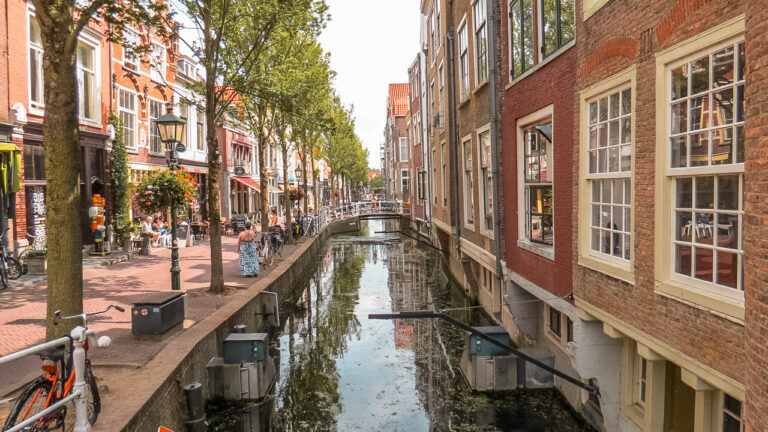
After the visit, you can head to the main canals, designated as UNESCO World Heritage sites. The areas between Prinsengracht and Herengracht feature facades from the Dutch Golden Age, old warehouses, and wooden bridges. Take a moment to observe the loading hooks on the facades, the leaning houses, and the houseboats where people live year-round.
📌 Useful tip: if you have time between Jordaan and the Red Light District, take a detour to the “Nine Streets.” It’s a small stretch with cafés, bookstores, and local shops, perfect for a break before continuing.
Later, you can cross into the Red Light District, formally known as De Wallen. It’s the oldest area of Amsterdam, developed around the medieval port, where by the 14th century, taverns, inns, and small brothels catered to sailors and merchants arriving in the city. The name “Wallen” refers to the old defenses and walls that surrounded this part of the historic center.
📷 Take this guided tour of Amsterdam’s Red Light District.
In the center of the district is Oude Kerk, the oldest church in the city (1306). Surrounding it are very narrow streets, 17th-century houses, and canals like Oudezijds Voorburgwal, one of the first to be urbanized when Amsterdam began to expand. The area has maintained this medieval structure, which is why it has such narrow passages and a layout different from the rest of the center.

Day 2: Museumplein and De Pijp Neighborhood
The second day starts at Museumplein, the large square created in the late 19th century when Amsterdam gathered its most important museums in one area. Today, it houses the Rijksmuseum, the Van Gogh Museum, the Stedelijk, and the Moco. It’s common to choose one of the major museums, as visiting both in one morning requires time or an early start.
If you start with the Rijksmuseum, you’ll see works from the Dutch Golden Age, like The Night Watch by Rembrandt and historical pieces related to the country’s commercial expansion. If you choose the Van Gogh Museum, the collection follows his life chronologically and showcases paintings, letters, and sketches that aren’t usually found in other museums worldwide. In both cases, it’s better to buy timed tickets, as slots fill up quickly.
📷 Book a guided tour of the Rijksmuseum, with entry and a guide at your disposal. If you’re more interested in the Van Gogh Museum, book a guided tour of the Van Gogh Museum with tickets included.
After the visit, you can head to Vondelpark, opened in 1865 and named after the poet Joost van den Vondel. The park retains part of its original design, with ponds, wide paths, and an open-air theater where free performances have been held since 1974 during the summer. It also features sculptures, like Picasso’s The Fish, installed in 1965. It’s a nice spot to relax between museums before heading to De Pijp. We took advantage of the good weather to have a picnic on the grass.
As you enter De Pijp, you’ll notice a different layout than the center. This neighborhood was urbanized in the late 19th century to accommodate population growth and is filled with narrow buildings, local shops, and a mix of communities that give it its own identity. Today, it has cafés, bakeries, international restaurants, and small galleries.
The most significant place in the neighborhood is the Albert Cuyp Market, open since 1905 and considered one of the largest street markets in Europe. Here, you’ll find stalls selling fruits, vegetables, cheeses, fish, freshly made stroopwafels, and typical Dutch products.
After the market, you can continue through the side streets of De Pijp, where there are traditional breweries like Brouwerij Troost and small art studios. If you finish early, you can walk to Stadhouderskade, which is just a few minutes away, where several boat tours depart to explore the main canals.
📷 We recommend this low-cost option! Take a boat ride through the canals of Amsterdam.

Recommended Cuisine for 2 Days in Amsterdam
On a two-day trip, you don’t need to search for too many places to eat. With these options, you can try the most typical flavors of Amsterdam without straying from the itinerary.
• Freshly made stroopwafels, found at the Albert Cuyp Market, and it’s worth trying them warm.
• Herring with onions and pickles, a street food bite to keep you moving without wasting time.
• Dutch cheeses, from Gouda to more mature varieties that you can sample in shops in the center.
• Pannenkoeken or poffertjes, quick sweets that work well for breakfast.
• Fries with local sauces, handy if you get a craving while walking.
• Jenever, the traditional drink you can order in classic bars in the center.
Interestingly, in Amsterdam, you’ll see many “Argentinian” restaurants scattered throughout the city. They often have names written in Dutch, something like “Restaurantje Argentinje” or similar variations, and what’s striking is that they offer grilled meats, empanadas, and milanesa even in very touristy areas. It’s not always clear if the owners are Argentinian or not, but it’s surprising to see how many there are and how popular they are among visitors.
If you want to try something more without complicating things, look for places along the marked routes of the itinerary. Everything on this list is easy to find while exploring the city.

Practical Tips for a Trip to Amsterdam in 2 Days
In two days, every segment counts, so it’s good to have some details clear to avoid wasting time on transfers or lines.
• Book the Anne Frank House in advance, as tickets often sell out even in low season.
• Buy museum tickets online, as assigned times help organize your morning better.
• Walk whenever you can, since the routes in the center and along the canals are short and faster than the tram during busy hours.
• Avoid cycling traffic on major avenues, especially if you’re not used to it, as bikes have priority and move at a good pace.
• Check the weather before heading out, as sudden rain can change your plans, and it’s good to have an alternate plan nearby.
• Visit markets and neighborhoods early, especially Albert Cuyp, when there are fewer people and you can walk more comfortably.
🔝 How to travel cheaply in Amsterdam? – Amsterdam isn’t an economical city to visit, so check out this article for tips on traveling cheaply in the capital of the Netherlands.
Where to Stay in Amsterdam?
The historic center is convenient if you want to be close to everything: Dam Square, the Anne Frank House, and the main museums. There’s transportation in all directions and plenty of accommodation options.
-
- The Jordaan neighborhood is quiet and residential, with canals, cafés, and galleries. It’s ideal if you’re looking for a more local and less touristy area.
-
- De Pijp combines multicultural life with more affordable prices. It has good tram and metro connections, with the Albert Cuyp Market as a central point.
-
- Leidseplein is the best area for nightlife, filled with bars, theaters, and music venues, plus it’s well connected to the rest of the city.
To make it easier for you to choose where to stay in Amsterdam, here are three options we know that suit different types of trips:
-
- Hotel Van Gogh: Located in Museumplein, right next to the Van Gogh Museum. It’s a modern hotel with details inspired by the artist’s works. It has double and triple rooms, comfortable for families or friends, and an excellent location for walking around the museum area.
-
- HEGRA by Stanley Collection: Occupies one of the historic houses of former merchants by the canals. It’s a good option if you’re looking for a charming stay with water views. It’s close to Dam Square, the Anne Frank House, and the “Nine Streets,” an area full of shops and cafés.
-
- Eric Vökel Boutique Apartments – Amsterdam Suites: Spacious and bright apartments with a fully equipped kitchen and dishwasher, ideal for families or longer stays. They’re next to the Central Station, a practical location if you arrive by train or want to take excursions from the city.
🏨 Find the best accommodation in Amsterdam here.
With these points, you have the essentials to make the most of your two days without any hassle.