It is known as the city of three cultures, since Christians, Muslims, and Jews once lived here. In this article, we’ll tell you things to do in Toledo, to enjoy an incredible visit to this city that looks like it came out of a fairytale.
The city of Toledo is the perfect mix of culture, history, and gastronomy. Its historic center has preserved its medieval identity, which earned it recognition as a UNESCO World Heritage Site since 1986.
Toledo, a bit of history
Toledo, the capital of Castilla-La Mancha, is a city marked by conquests and power struggles.
Its origins date back to a walled settlement on the banks of the Tagus River, later conquered by the Romans around 193 BC. Remnants from that time can still be seen, such as the foundations of the aqueduct that crossed the river. During the Middle Ages, the Visigoths arrived and made it the capital of their kingdom.
In the year 711, the city was conquered by the Arabs. Thanks to their Muslim religion and architectural influence, many buildings in Toledo still showcase this style today.
At the beginning of the 11th century, it fell into the hands of the Castilian Kings, who established an agreement of respect with minority groups. This peace lasted nearly three centuries until hostility grew, eventually leading to the expulsion of the Jews.
From then on, Spain’s history grew more complex with battles and internal conflicts. In the Modern Age, the Catholic Monarchs developed Toledo, but in 1561 it lost its status as the capital, which was transferred to Madrid.
Since 1986, Toledo has been part of the UNESCO World Heritage list.
How to get to Toledo?
Toledo is an ideal city for a day trip from Madrid. It’s just 30 minutes away by high-speed train from Atocha station and about an hour by car.
📷 Book here the full-day excursion to Toledo from Madrid. Includes transport, guide, entrance to main sites, and meal options.
If you arrive by train, take a few minutes to admire the train station. It’s a neo-Mudejar style building decorated with arches and battlements. You’ll notice many handcrafted details such as tile mosaics, wrought-iron lamps, and carved latticework.
If you arrive by car, you’ll need to park outside, since the historic center is pedestrian-only. Toledo has some free parking areas that leave you at entry points with easy access to the old town.
🔔 The walled city of Toledo sits on a hill. To access it from the Tagus River banks, there are escalators that make the climb easier.
🔝 Looking for more day trips from Madrid? Check out this article on day trips near Madrid.
Things to do in Toledo
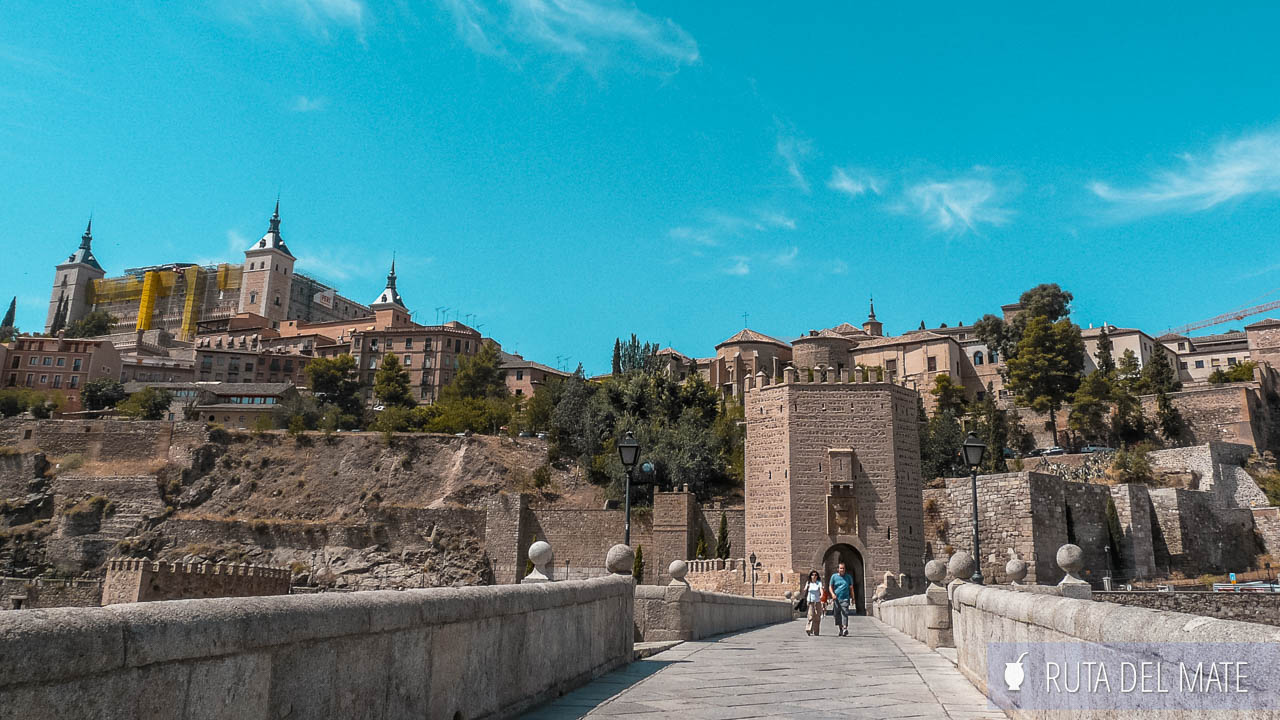
1) Cross the Alcántara Bridge
This bridge connected the city across the Tagus River with the roads leading to Mérida and Zaragoza back in Roman times. Due to floods, the bridge was damaged and later rebuilt by the Arabs. Its name comes from Arabic, where Alcántara means bridge.
The second major reconstruction was under King Alfonso X, when the tower was added. Later, the Catholic Monarchs placed their coat of arms and added a toll known as Portazgo, charged to those who crossed the bridge but didn’t live in Toledo.
We recommend heading down to the riverbank to take a photo of this classic Toledo postcard.
📷 Book here the free tour of Toledo to discover the city of three cultures with an expert guide.
2) Discover the City Gates
The historic center of Toledo is surrounded by a wall. To enter the city, you had to pass through one of its gates, and fortunately, some of them still remain. The most notable are:
- Bisagra Gate: Originally known as the old gate bab al Shaqra, it’s one of the city’s oldest entrances. In the 16th century, it was rebuilt with materials from the original, earning it the name “New Gate.” At the top is a statue of an Angel, included to protect the city. It’s one of the most beautiful gates in Toledo.
- Cambrón Gate: Its name comes from thorny bushes that grew nearby. It was the closest gate to the Jewish quarter, so it was also called the “Gate of the Jews.” It’s believed to have been built by the Visigoths, though its decorations are in Mudejar style.
- Alcántara Gate: located opposite the Alcántara Bridge, it consists of an arch between two square towers. In the Middle Ages, it was used for pedestrian and goods access. You can still see the windows used for defense with bows.
- Sun Gate: This square tower was built onto the original Roman wall. In one of its later modifications, a marble medallion was added depicting a miracle story from Toledo. In this scene, both the sun and the moon appear, which gave the gate its name.
📷 Book here the guided tour of Toledo of the three cultures. Visit the city’s main mosques, synagogues, and churches.

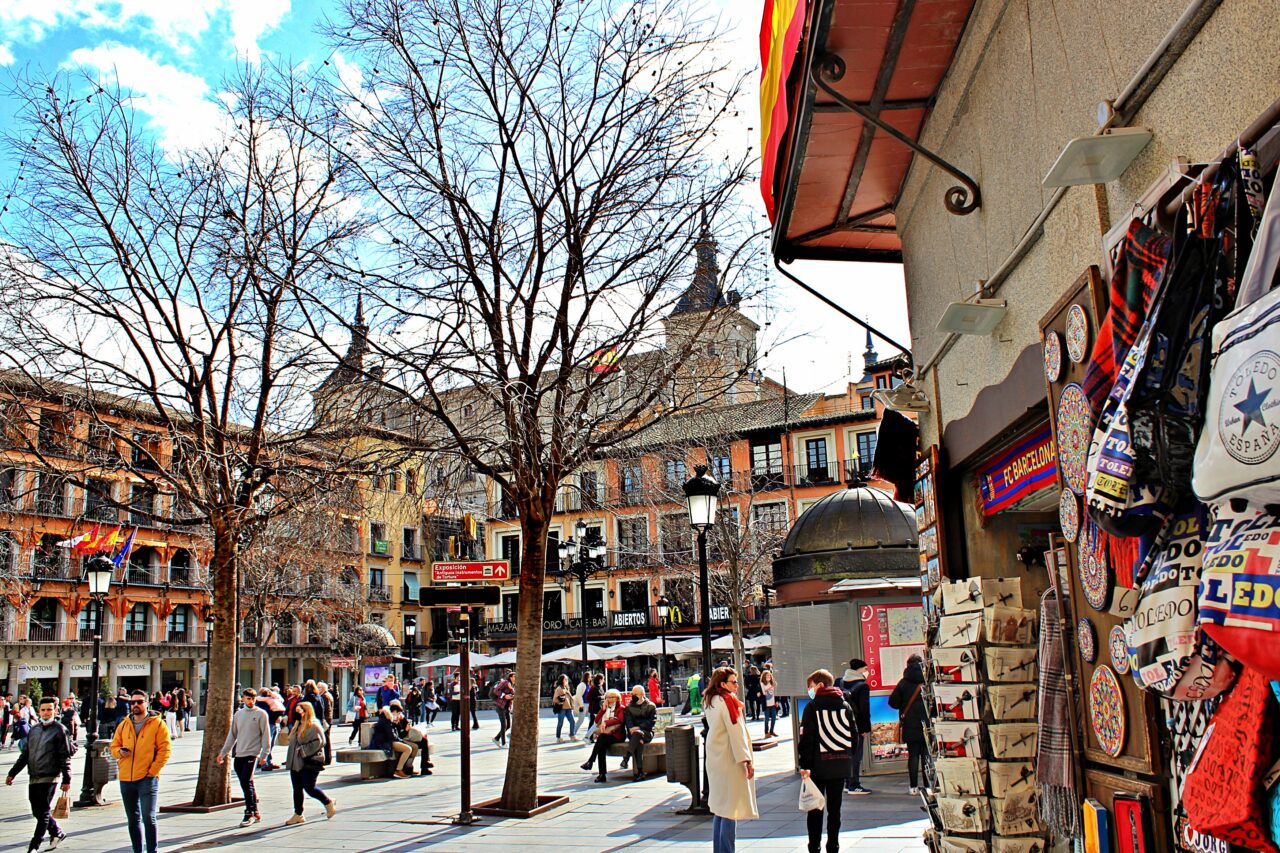
3) Stroll around Zocodover Square and try a typical dish
The main square of Toledo began as a market for pack animals and gradually became the heart of the city. Over its history, it has also hosted events such as bullfights and a climbing game known as cucaña. It’s even believed that public executions were held here during the Inquisition.
Today, the square is surrounded by bars and restaurants, perfect for tasting typical local dishes during your visit to Toledo.
🍺 If you’re in Toledo, take the chance to try its famous marzipan. These sweets are made from almonds, sugar, and egg. The earliest written records of this recipe date back to the year 1512 in this very city.
4) Admire the Impressive Toledo Cathedral
The cathedral was built in 1226 on the remains of a Visigothic church that once stood on the site, which had also been used as a mosque. It is built in Gothic style using white stone and is considered one of the last great examples of this architectural style.
Its façade clearly shows how French Gothic influence inspired the design of this cathedral. It has three main doors: the Door of Forgiveness, the Door of the Last Judgment, and the Door of Hell. These are usually closed, but it’s worth taking a few minutes to admire their details and decoration.
Walking around the cathedral, you’ll find two additional entrances: the “Clock Door” and the “Lions’ Door.” The first is named after the clock on its upper part and features a carved scene believed to represent the legend of Charlemagne and Princess Galiana. The Lions’ Door owes its name to the lion sculptures that adorn it, although it is also known as “the New Door,” being the last one added.
The interior is filled with light and holds many valuable works of art. Highlights include the choir stalls, the main altarpiece (one of the last in Gothic style), and the Gothic cloister. One of the most curious treasures kept here is the monstrance, crafted with the first gold that Christopher Columbus brought back from the Americas.
📷 Book here the guided tour of Toledo Cathedral. With an expert guide, you’ll uncover the secrets of the second largest cathedral in Spain.
5) Explore the Alcázar of Toledo
It began as a large military and civil fortress, strategically located on Toledo’s highest point. Its name comes from Arabic, “Al Qasar.” Over the years and under different rulers, it was modified until becoming a fortified palace with a square layout and towers at its corners. It was eventually adapted into a royal residence for Charles I of Spain.
Finally, in 1545, architect Alonso de Covarrubias gave it its current design. Its towers reach 60 meters high and are topped with wooden and iron spires.
Inside the Alcázar, you’ll find other institutions such as the Spanish Army Museum and the Library of Castilla-La Mancha.
The museum features 13 rooms covering Spain’s military history, including weapon collections and exhibits dedicated to the Alcázar itself.
The library, housed in one of the Alcázar’s towers, includes a café that is perfect for enjoying a coffee while admiring magnificent panoramic views.
📢 El Alcázar tiene entrada gratuita todos los miércoles del año. Además, en las fechas: 29 de marzo, 18 de abril, 18 de mayo, 12 de octubre y 6 de diciembre. También es gratis para menores de 18 años y mayores de 65 años residentes en la UE. Precio general: 5€.
6) Visit the Hospital and Museum of Santa Cruz
This former orphanage and hospital was founded to shelter abandoned children. Inside, the façade, cloister, and staircases are richly decorated with hand-carved wooden details, making it worth a visit for the craftsmanship alone.
Today, it is the city’s main art and archaeology museum. Here you can find Paleolithic mammoth tusks, Roman mosaics, and works by El Greco.
📷 Want to see the city from another perspective? Book here the Toledo hop-on hop-off bus, where you can get on and off as many times as you want, or try a
7) Discover the Cristo de la Luz Mosque
This small Muslim construction is the best preserved of its kind. The mosque was built in 999 as a private oratory for the Banū l-Hadīdī family. In later centuries, the site was donated to the Christian church. Because of its small size, it was difficult to adapt it, so additional buildings were added around it, leaving it almost hidden.
Thanks to travelers who rediscovered it in the 19th century, the site regained its value and was restored to be opened to the public.
Its interior stands out for its Mudejar-style details and white tones. Honestly, it isn’t spectacular, but it is the oldest religious building in the city, which gives it special importance. An entrance fee is charged, and the visit usually takes no more than 20 minutes.
8) Explore the Synagogue of El Tránsito and the Sephardic Museum
This synagogue is one of the few remnants of the Jewish community in Toledo, as most of the Jewish quarter was destroyed in 1491. It operated between 1357 and 1494, when it was closed following the expulsion of the Jews from Spain. In later years, it served as both a hospital and a church.
Its interior has been fully restored to show how it originally functioned. Today, it houses the Sephardic Museum, with rooms dedicated to the history of Sephardic Jews and their traditions.
The main prayer hall is decorated with Mudejar art, incorporating Hebrew inscriptions and coats of arms.
📢 On Saturdays from 2:00 PM and on Sundays, admission to the Synagogue of El Tránsito and the Sephardic Museum is free. It is also free on April 18, May 18, October 12, and December 6. General admission: €3.
9) Admire the Synagogue of Santa María la Blanca
It was the main Jewish temple in Toledo until the expulsion of the Jewish community. Its origins date back to the 13th century, and it functioned as a synagogue for 211 years.
The building consists of five naves separated by horseshoe-shaped arches decorated with floral plaster motifs. Its 32 columns are topped with pinecone carvings that intertwine to form perfect Mudejar-style decorations.
To enter, you must purchase a ticket, and filming inside is not allowed.
10) Visit the Church of Santo Tomé and see “The Burial of the Count of Orgaz”
The Church of Santo Tomé was founded after the reconquest of Toledo by King Alfonso VI of León. Its origins date back to an 11th-century mosque.
Thanks to a reconstruction financed by the Señor de Orgaz, the church was restored and enhanced, adding a bell tower on the old minaret of the mosque.
While the church features interesting works such as the altarpiece and paintings by Luis Tristán, the true masterpiece is El Greco’s “The Burial of the Count of Orgaz”. This nearly five-meter oil painting is considered the artist’s greatest work.
11) Explore the El Greco Museum
This museum is dedicated to El Greco, an important painter not only for the art world but particularly for Toledo. Many of the works displayed here were once scattered throughout the city, at risk of being lost or damaged.
The museum was founded in 1910 by the Marquis de la Vega-Inclán, who decided to recreate it as the house of El Greco. One of its most important pieces is the plan of Toledo, which was key to studying what the city was like at the beginning of the 17th century.
Additionally, in the basement of the museum, you can visit what were once the ritual Jewish baths of the synagogue.
12) Admire the Monastery of San Juan de los Reyes
This monastery was founded by the Catholic Monarchs for the Franciscan monks. Queen Isabella originally planned this majestic place as her final resting place, but after conquering Granada she changed her mind.
The style of this construction combines Gothic and Mudejar. On the outer walls of the monastery, you can see the chains that were once used by Christian prisoners who were freed after the conquest of Granada.
🔝 Are you visiting Castilla-La Mancha? Check out this article on the Don Quixote route by car.
13) Explore the city at night with a tour
At night, the narrow streets of downtown Toledo are like a picture postcard, with the facades of historic monuments beautifully illuminated.
It’s the perfect time to take one of the night tours and discover another side of the city, full of mysteries, legends, and stories of the Knights Templar.
Before leaving, take a souvenir photo at the viewpoint
Before heading back, don’t miss visiting the Mirador del Valle or the Mirador de los Cigarrales. Crossing the Tagus River, you’ll reach these viewpoints that offer a panoramic postcard view of the old city crowned by the Alcázar.
Keep in mind that the viewpoints are located on a steep hill. You can get there by car, take the tourist bus that stops there, or walk from the train station (about 30 minutes uphill).
Where to stay in Toledo
There’s a wide variety of accommodations in Toledo. If you’re arriving by train or bus, the best option is to stay in the historic center. If you’re coming by car, it might be more convenient to stay just outside the historic center, but still close to the main attractions.
Our recommendations for where to stay in Toledo are the following:
- Oasis Backpackers’ Toledo: ideal for backpackers, just a few meters from Plaza Zocodover. It offers shared and private rooms, plus a terrace and bar to meet other travelers.
- Apartamentos Nuncio Viejo: perfect for couples or families, located very close to Toledo Cathedral. Set in a historic building, it preserves its traditional interior courtyard and architecture. Some rooms have balconies with cathedral views.
- Hotel Carlos V: located in the heart of the historic center, it features modern rooms with views. Highlights include the Mudejar-style dining room, buffet breakfast, and a stunning rooftop terrace.
- Hotel Zentral Mayoral: a great option if you’re driving and prefer to stay outside the historic center. It offers parking, a full breakfast, and modern facilities.
🏨 Want to look for other options? Find the best accommodation in Toledo here
What you need for your trips to Europe
Plan your journey easily with these trusted resources: