
Here’s everything you need to know to how visit Pompeii from Naples: what to see, and all the essential tips to explore this famous site that was buried by the eruption of Mount Vesuvius.
We didn’t know what we were going to find there after reading this description: “Pompeii is a city that remained buried for 17 centuries under the lava of a volcano that erupted in the 1st century AD.” And not only that—just a few years before the eruption, a massive earthquake had already half-destroyed the city.
Seen from Naples, Mount Vesuvius is imposing, towering in the distance beyond the bay, with the peaceful-looking villages along the Sorrento coast below it.
I say peaceful because in reality Vesuvius is not extinct; it’s still an active volcano that could erupt at any moment (the last time was in 1944, though not a major eruption). While there is no imminent danger, it’s worth noting that it hasn’t erupted in a devastating way for over 500 years.
🔝 Check out this article on things to do in Naples, with recommendations on where to stay and how to get there.

1) Visiting Pompeii: a bit of history
To visit Pompeii, we entered through the Porta Marina, named this way because it faces the sea. During our tour of this city unearthed from the ashes, whose ruins are a UNESCO World Heritage Site, these facts stood out to us:
- Pompeii had a history spanning 8 centuries, but all of it took place over 2,000 years ago. It was founded in the 7th century BC and came to an end in the 1st century AD. For centuries, it was thought the city had vanished, that nothing could remain under the hardened lava. It seems it was rediscovered in the 16th century, but proper archaeological excavations only began in the 18th century.
- It is one of the few places where you can see the original street layout, untouched and unchanged. What you see today is exactly what existed 2,000 years ago.
- Thanks to the archaeologists’ work, we can now appreciate details of daily life in this city of 20,000 inhabitants—its activity, its routines, and its urban rhythm.
📷 Book here the excursion to Pompeii from Naples with guide so you don’t miss a thing. If you prefer a guided tour starting in Pompeii, book the Pompeii guided tour.

2) What to see in the ruins of Pompeii?
The main highlights to see in the ruins of Pompeii are:
- The Forum and the Basilica (which was actually a courthouse), several public administration buildings, and the Macellum: as in all Roman cities, this was the center of daily life. The Macellum, located next to the Forum, was Pompeii’s main marketplace.
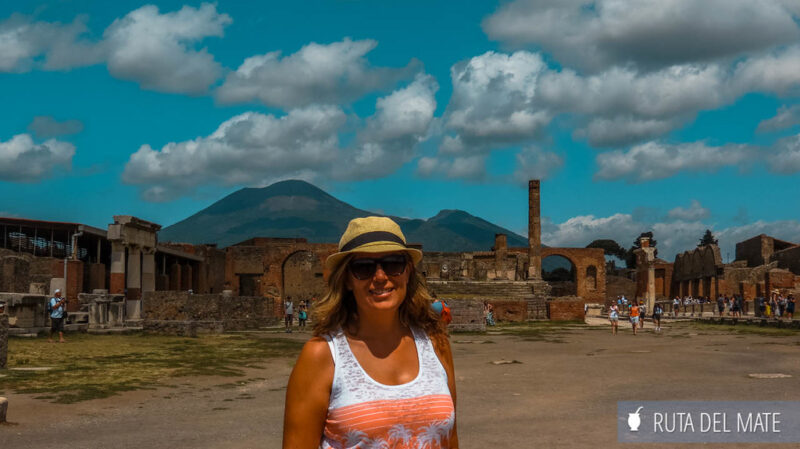
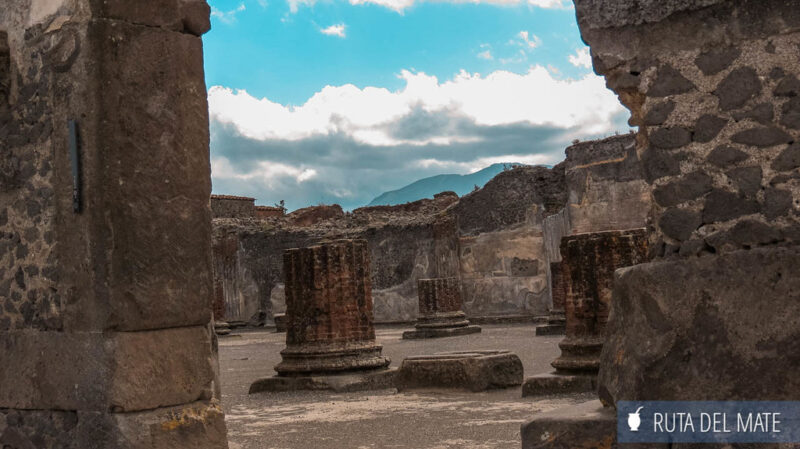
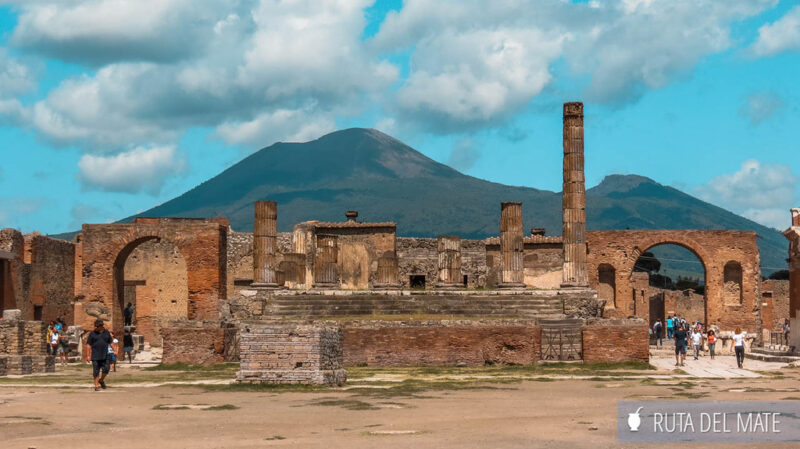
- The Temple of Jupiter: after entering through Porta Marina and arriving at the Forum, you’ll see it standing under the shadow of the imposing Vesuvius. It was dedicated to the Capitoline Triad: Jupiter, Juno, and Minerva.
- The Stabian Baths, where the townspeople bathed.

- The wealthy houses, including the House of the Faun, named after a small statue found in one of its fountains. It was one of the largest houses in the city.
The actual owners of many of these houses are unknown, so their names come from the objects found inside them.

The wealthiest were also able to afford land in the city to build temples, such as the Temple of Fortuna Augusta, dedicated to Emperor Augustus.
We were amazed to still find works of art inside the houses: carvings, paintings, mosaics, many of which have survived despite the centuries and the volcanic eruption that buried them for so long.

- The House of the Oven is one of the 35 bakeries excavated so far.
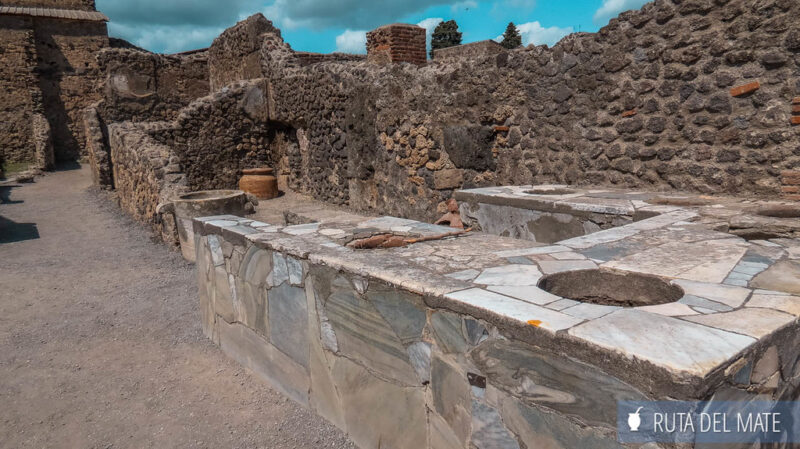
- The street food and drink stalls, of which there were nearly 90, including the Thermopolium Caupona. There were so many because apparently it was common practice at the time to have lunch outside.
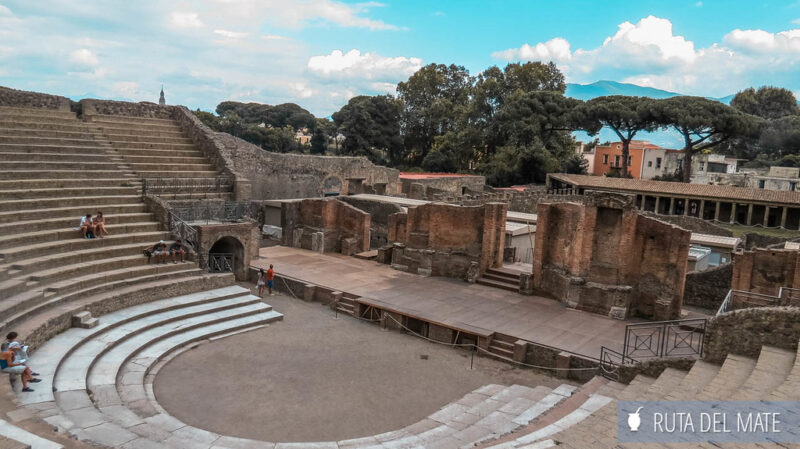
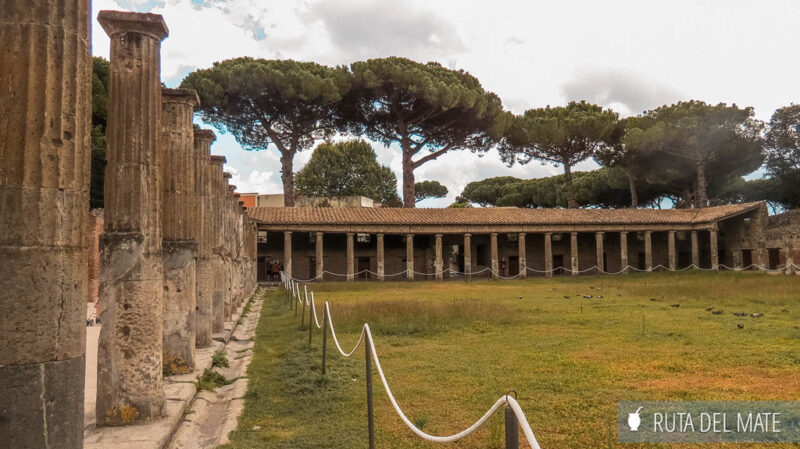
- The Amphitheater, the Large Theater, the Small Theater, and the Quadriporticus of the Theaters. The Amphitheater is one of the oldest and best preserved, used for gladiator combats.
- The extramural cemetery, just across the Porta Nocera, with several tombs featuring striking details.
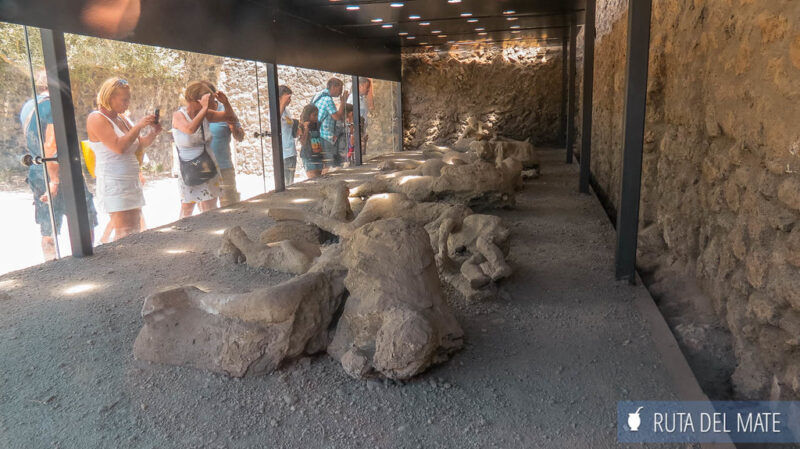
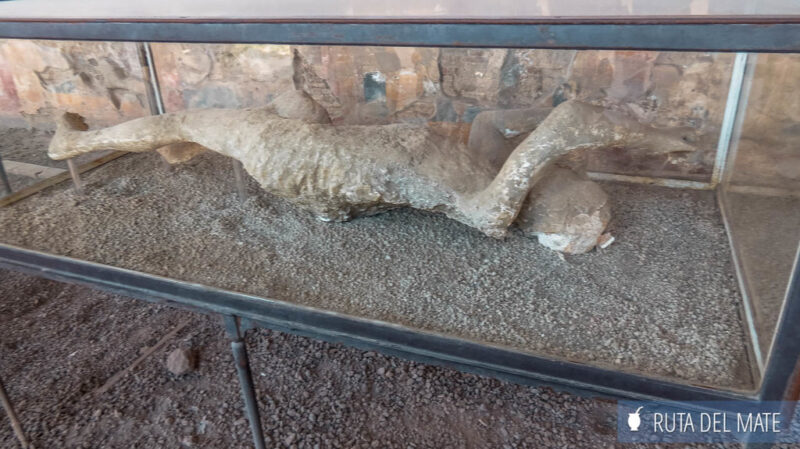
- Perhaps one of the most incredible things to see in Pompeii, among so many ruins, are the casts of the people caught by the eruption 2,000 years ago, who in that moment had no idea what was happening. These casts can be seen in several parts of Pompeii, including the Garden of the Fugitives.
These figures were created using the plaster casting technique. Archaeologists poured liquid plaster into the voids left in the hardened ash (after the bodies decomposed), producing solid forms that reveal human shapes in different postures: protecting themselves, holding onto someone, or clinging to something valuable.
3) Tips for visiting Pompeii
- If visiting in summer, watch out for the heat. Bring a hat, sunglasses, and sunscreen. I came back with a T-shirt tan line.
- There are fountains to refill your water bottles. The water isn’t very cold in summer, but it’s still drinkable.
- Be careful: the shops right outside the train station sell tours. Skip the crowd and walk straight to the proper line to buy your tickets. There you’ll also find official guides available in many languages. Also, while waiting in line, check the booth to the left: they hand out excellent maps and booklets that explain the city like an audio guide. Just follow the numbers.
- It took us about 4 hours to explore. Many original pieces, such as the Faun statue, are kept in the National Archaeological Museum of Naples. So the Pompeii visit is best complemented with a stop at this museum.
Practical info for visiting Pompeii
Where to eat in Pompeii
There is a designated picnic area inside the site if you want to bring your own food. If you didn’t know you could bring a packed lunch, behind the Forum there’s a restaurant selling pizza slices—tasty, cheesy, and at a fair price. They also sell other dishes. It’s not cheap, but remember you can refill your water bottles at the fountains outside.
If you want a unique dining experience, you can eat at Caupona Pompei, a place that recreates the ambiance and recipes of ancient Roman taverns.
Where to stay in Pompeii
If you’re only visiting the ruins, there are plenty of accommodations near the train station. You can also stay in modern Pompeii town, which is not far either.
Our recommendations for staying in Pompeii are:
- Villa Flora: modern rooms close to the ruins entrance. It has a shaded courtyard, great for the hot summer. Free parking if you’re driving.
- Hotel del Sole: a four-star hotel with quality facilities in central Pompeii. Its terrace offers breakfast with wide windows and views of Vesuvius. Rooms are spacious and comfortable.
🏨 Looking for other options? Find the best accommodation in Pompeii here.
If, like us, you plan to return to Naples after your visit, you can check hotels in Naples and book directly here.
How to get from Naples to Pompeii?
We took the Circumvesuviana train from Naples’ Garibaldi Station, which runs to Sorrento and stops at Pompeii-Scavi-Villa dei Misteri, near the site entrance. Journey time: about 40 minutes.
What you need for your trips to Europe
Plan your journey easily with these trusted resources: