If you’re thinking about taking a trip around the surroundings of Florence, here’s a list of towns to visit in Tuscany that are truly worth seeing, along with what to see in each of them.
Tuscany is a region in central-northern Italy, famous for its rolling hills and fields of vineyards, olive groves, and lemon trees. With the Apennines bordering it to the east, Tuscany has one of the highest concentrations of well-preserved medieval towns in Italy, many of them still surrounded by original walls and with an urban layout almost untouched for centuries.
In this article, we’ll show you 12 towns you can’t miss if you’re visiting Tuscany. We’ll also recommend where to eat and where to stay in each place.
💯 Check out our article on Things to do in Florence, the main city in Tuscany. A visit that’s worth at least two days.
How many days do you need to visit the towns of Tuscany?
Ideally, to explore Tuscany you should plan for at least 7 days. In that time, you can visit 8 to 12 towns, depending on the stops you choose and your pace. The towns are usually 30–40 km apart, so you can visit 2 or even 3 in one day, especially in the Chianti Valley.
Although you can get there by public transport, it’s best to rent a car to save time and enjoy more freedom. If you start from Florence, you can cover in 7 days a very complete mix of towns from the north, center, and south of Tuscany, without repeating routes. You can also take the classic north-to-south route, starting in the Chianti Valley and ending in Bagno Vignoni.
Finally, it’s important to choose the right time of year since summers can get very hot. Spring (April to June) and autumn (September and October) are the most recommended seasons to visit, and there are fewer tourists.
1. Volterra
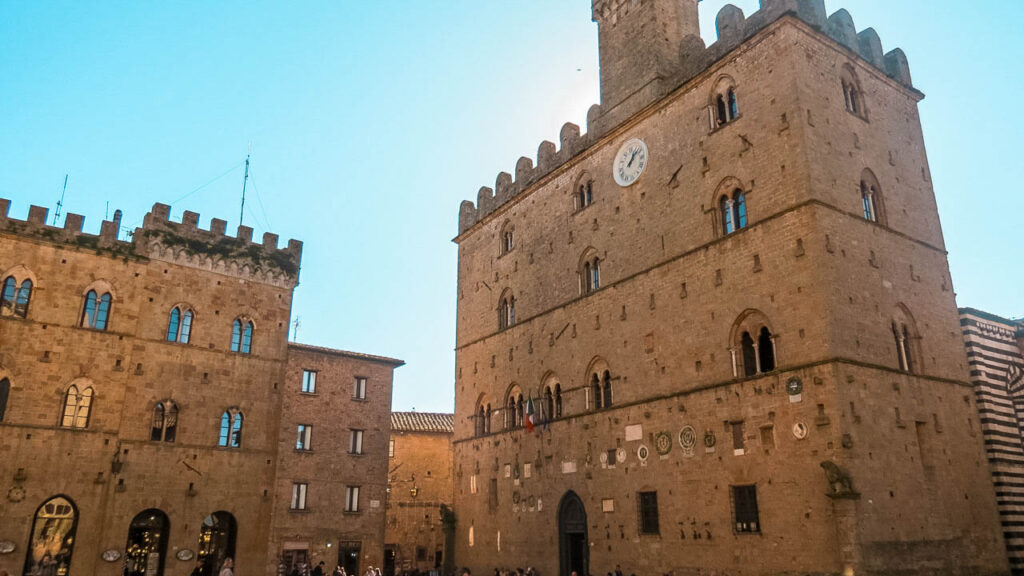
Volterra is an ancient city founded by the Etruscans around the 8th century BC. Its most visited attractions are the Romanesque-Gothic cathedral known as Cattedrale di Santa Maria Assunta, located in Piazza dei Priori, and its Roman Theatre from the 1st century BC—one of the best-preserved Roman theatres in Tuscany. It’s ideal to visit if you love classical Roman architecture and history.
For dining, Ristorante Torre del Porcellino, just steps from Piazza dei Priori, offers classic Tuscan dishes, local wines, and an outdoor terrace with views over Vicolo delle Prigioni, one of the charming alleys in the historic center of Volterra.
If you stay at Hotel Etruria, you’ll be just a few meters from the ristorante and the historic center. This family-run hotel is well-rated for its value for money and has a panoramic garden and its own café.
📷 Book the Winery Guided Tour and Experience with Tasting in Volterra.
2. Lucca
Lucca is a lively university city famous for its impressive Renaissance wall surrounding the entire old town, perfect for cycling or walking along. Guinigi Tower, with trees growing on its top and panoramic views, is one of its most popular attractions.
You also can’t miss the Piazza dell’Anfiteatro for a coffee or a pistachio gelato. It’s built on the site of an ancient Roman amphitheater!
For dining, Osteria Baralla is near the wall and serves an authentic Tuscan menu with dishes such as ribollita or tortelli lucchesi.
For accommodation, Hotel Ilaria is just a few minutes’ walk from the center, set in a historic building and known for its excellent value for money.
📷 If you’re in Florence, book here the tour that includes visiting Lucca and Pisa in the same day.
💯 Check out our article on things to do in Pisa besides the tower.

3. San Gimignano
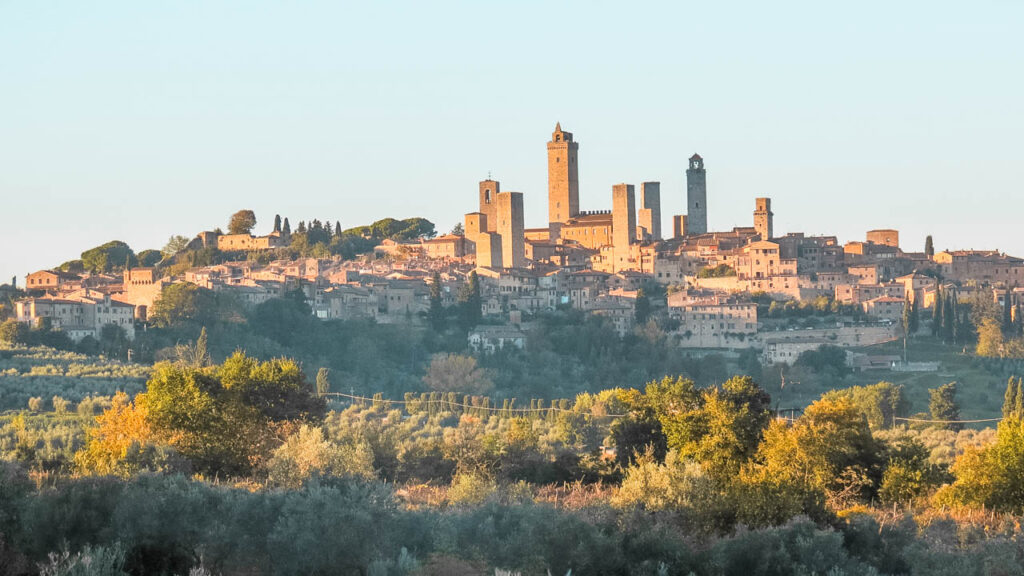
Known as “the city of towers,” San Gimignano is famous for its numerous well-preserved medieval towers. Piazza della Cisterna, Piazza del Duomo, and the Collegiata di San Gimignano are its most famous and most visited attractions. They are must-sees if you enjoy art and medieval architecture.
Trattoria Chiribiri, located in Piazza della Madonna just a few steps from Porta San Giovanni, is highly recommended by both locals and tourists for its traditional dishes and regional wines. Reservations are advised since the place is small and fills up quickly.
If you want to stay near the center, Hotel La Cisterna, located in the main square, is ideal for exploring the town without transportation, and its rooms are very comfortable.
📷 This tour to San Gimignano, Siena, and Pisa from Florence will let you see it all.
4. Montalcino
Montalcino, in the province of Siena, is a 13th-century medieval fortress still very well preserved today. It is surrounded by vineyards where Brunello wine, one of Italy’s most prestigious wines, is produced.
Its historic center, La Fortezza di Montalcino, was built in 1361 at the highest point of the city. It’s the best spot to get panoramic views of the town.
Osteria Le Potazzine, located near the fortress, is famous for its Tuscan dishes paired with excellent local wines. It’s very popular, so booking in advance is recommended.
For accommodation, Hotel Dei Capitani, located in the historic center, offers rooms with views of the Apennines. Its location is very convenient for exploring the town.
🍇 Book your Montalcino Wine Tour here.
5. Monteriggioni
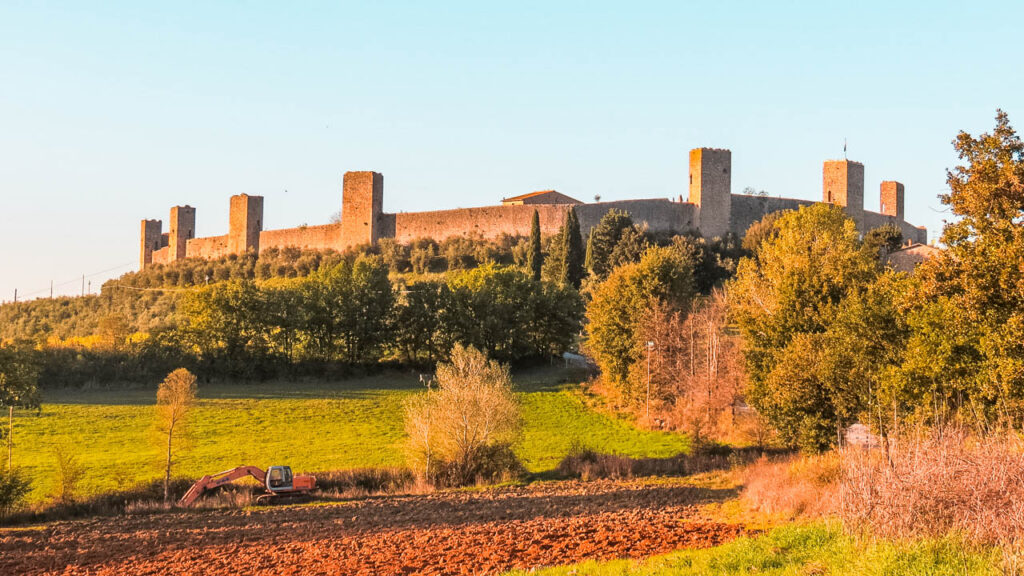
Monteriggioni is a walled village that has preserved its medieval towers intact. The wall completely surrounds the village, and you can walk along it to enjoy views of the village and surroundings.
Taverna di San Giuseppe, located just a few meters from Piazza del Campo, is a classic spot to try authentic Tuscan cuisine. It’s highly rated for its value for money.
If you’re looking for peace and quiet, resort Borgo San Luigi, located outside the village, has a pool and a large garden and also offers a wellness center with massages and relaxing treatments. Ideal to cool off during the Tuscan summer.
📷 Book here the tour to Pienza, Monteriggioni, and Montalcino from Florence.
6. Pienza
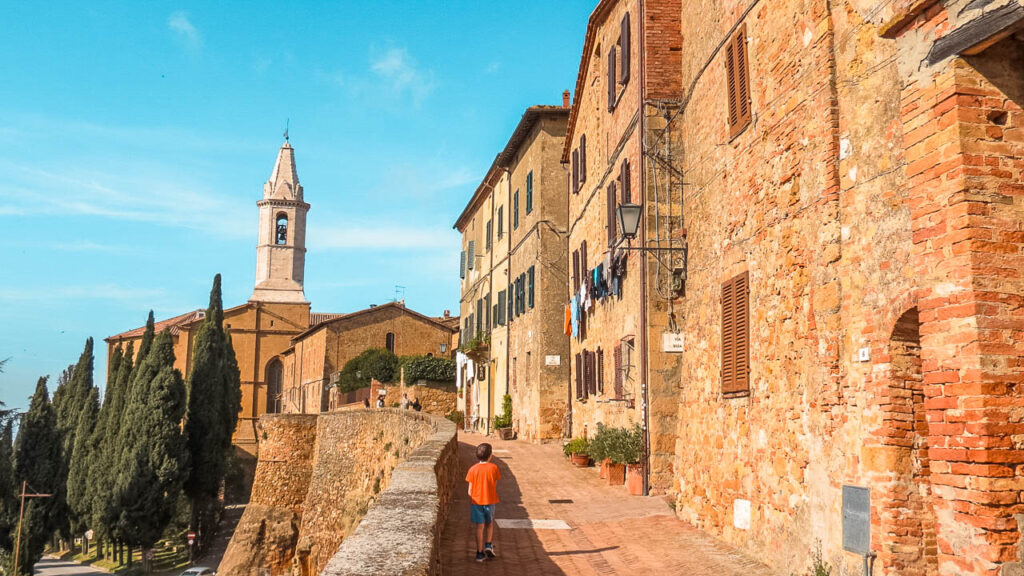
A UNESCO World Heritage Site, Pienza is the first planned Renaissance city. It was designed by Bernardo Rossellino at the request of Pope Pius II in the mid-15th century. It still preserves parts of its medieval walls integrated into the city. It’s also famous for producing pecorino cheese, a sheep’s milk cheese that can be fruity or sharp—and you can’t miss it.
Walking along Corso Rossellino leads you to Trattoria La Porta, a cheese lover’s paradise, where you can taste pecorino and other artisanal cheese varieties. Just a few meters away is the central Piazza Pio II, surrounded by local attractions such as the Duomo, Palazzo Comunale, and Palazzo Piccolomini, with its famous hanging garden.
And why not spend the night in a convent? Relais Il Chiostro di Pienza, set in a former 13th-century monastery near the center, offers this unique experience without sacrificing comfort.
7. Montepulciano
Another must-stop if you love wine is Montepulciano, a walled city dating back to the 14th century. Its exclusive local wine, Nobile, is one of the oldest and most prestigious in Italy.
Piazza Grande is the highest point in the city, where many noble families built their residences during the Renaissance. You can visit some of the palaces around the square, such as the Palazzo Comunale or the Cattedrale di Santa Maria Assunta. Some offer guided tours and panoramic views, while others function as museums.
In the center, on Via di Gracciano nel Corso, you’ll find Osteria Acquacheta, famous for its generously served bistecca alla fiorentina. It often fills up, so booking in advance is recommended.
Near the Osteria, you can stay at Albergo Il Marzocco, a historic house with a terrace just steps from the center and well located for visiting nearby wineries.
🍇 Book here the tour to Montepulciano and Pienza from Florence, which also includes a wine tasting.

8. Siena, one of the must-sees in Tuscany
Siena was one of the most prosperous cities of the Middle Ages and a direct rival of Florence. It still preserves much of its original urban layout within the walls. For us, after Florence and Pisa, it’s the third must-visit place in Tuscany.
At the heart of its historic center is the Piazza del Campo, a fan-shaped square where the Palio di Siena takes place — a medieval-style horse race held every July 2 and August 16. Entry is free, but it’s best to arrive early as there are no seats.
In addition to the Palio, you can visit the Duomo di Siena, a Gothic-style cathedral with black and white marble, sculptures by Donatello, and a floor decorated with biblical scenes.
Just a few steps from the center is La Taverna di San Giuseppe, a restaurant located in an ancient Etruscan cave serving traditional dishes and local wines.
For accommodation, Hotel Athena is inside the walls and offers rooms with views of the Tuscan landscape, free parking, and its own restaurant.
📷 Book here the guided tour of Siena to discover this fantastic city with an expert guide. Includes entry to the Siena Cathedral.

9. Pitigliano
Built on a hill of volcanic tuff, the city of Pitigliano in southern Tuscany is known as “Little Jerusalem” due to its historic Jewish community. Walking through the streets of its old town, you can find houses and passageways carved into the volcanic rock. The 16th-century Synagogue and the old ghetto are the most historically and culturally significant sites.
Near the center, you can stay at La Casa degli Archi, a small family-run hotel ideal if you’re looking for peace and quiet. Just a few meters from the hotel, I recommend trying the classic tiramisu on the terrace of Hostaria del Ceccottino.
10. Chianti Valley
The Chianti region, located between Florence and Siena, is made up of hills covered with vineyards and olive trees and medieval towns such as Greve, Radda, Castellina, and Panzano.
Visiting a wine estate is an essential part of the trip. The top three recommended are: Castello di Brolio, Castello di Ama, and Antinori nel Chianti Classico. It’s best to book for tours and tastings, and at some estates, you can also have lunch or dinner.
You can start in Greve in Chianti and then continue to Panzano and Castellina or Radda, where you can visit wineries and explore the historic centers. Ideally, choose three or four towns to visit in one day. For lunch, La Cantinetta di Rignana, in the rural area of Panzano, has tables overlooking the vineyards.
It’s worth returning to Greve to stay at Agriturismo La Camporena, a rural accommodation with a pool, surrounded by vineyards and olive groves.
🍇 Book here the Chianti Wine Tour from Florence, which includes visits to two wineries and tasting wines.
11. Bagno Vignoni
This small village is unique in Italy for having a Renaissance thermal pool in the center of its main square, Piazza delle Sorgenti. You can also visit the Chiesa di San Giovanni Battista, originally from the 13th century, which has been restored but retains its rural style.
Just a few meters from the square, La Bottega di Cacio serves platters of local cheeses and cold cuts that you can pair with an aperitif.
If you’re still in the mood for a thermal bath, at La Posta Hotel & Thermal Spa, you’ll find outdoor thermal pools with views of the Val d’Orcia.

12. Abbey of San Galgano
In the middle of the Tuscan countryside lie the ruins of the Abbey of San Galgano, a former Christian monastery built in the 13th century by the Cistercian Order.
It’s not one of the best-preserved medieval attractions, as it has no roof, but the entrance fee is affordable, and it can be explored on foot. Just a few meters away, in the Hermitage of Montesiepi (free entry), you’ll find the Sword in the Stone, placed there by Galgano Guidotti in the 12th century as a symbol of his renunciation of the knight’s life.
A few minutes’ walk away is Agriturismo San Galgano, accommodation within an old estate, surrounded by olive groves and vineyards, which also has its own restaurant. The dishes are made with produce from their own farm, making it the perfect place to eat and rest after exploring the Tuscan countryside.

What you need for your trips to Europe
Plan your journey easily with these trusted resources: