We spent a day in the Pink City and we want to tell you the best things to do in Toulouse in 1 day, one of the less visited cities in France but with plenty to do.
Toulouse, known in ancient times as Tolosa, was founded by the Romans in the 2nd century BC as an important colony in the region of Gaul. During the Roman period, the city prospered as a major commercial and administrative hub thanks to its strategic location on the trade routes connecting the Iberian Peninsula with northern Europe.
In the Middle Ages, Toulouse emerged as a regional power in southern France and also played a crucial role in the spread of Christianity, becoming an important pilgrimage center on the route to Santiago de Compostela.
Over the centuries, Toulouse remained an important cultural and economic center in southern France, attracting artists, intellectuals, and merchants from across Europe. Its architectural heritage, which includes the magnificent Basilica of Saint Sernin and the impressive Capitole, makes it one of the most important cities in the country.
To help you plan your one-day itinerary in Toulouse, we share, based on our own experience, all the main attractions of this city.
🔝 Our visit to Toulouse was part of a longer trip, where we explored other places in France. That’s why we suggest this 10-day France itinerary in case you want to take a similar trip.
Map – Things to do in Toulouse in 1 day
While visiting Toulouse in one day can be a challenge, it’s possible to make the most of your time if you plan your itinerary carefully.
Here’s a map with the points of interest we’ll cover on this tour. The order in which we present them is a suggestion on how you could structure your day to get an overall view of this city.
1) Toulouse Old Town – why is it called the Pink City?
Toulouse is known as the “Pink City” because of the distinctive color of its buildings, which are made of terracotta bricks (a popular construction choice at the time due to its durability and the availability of clay in the region). This pinkish hue comes from the clay turning that color when fired in the sun.
Beyond the aesthetic aspect, locals say that the pink color represents the warmth and hospitality of Toulouse’s people, as well as the softness of the climate and the light in southern France. You only need to visit to see it for yourself.
Today, it’s one of the most recognizable aspects of Toulouse’s architecture, and as you stroll through the city streets you’ll love the blend of pink tones combined with other pastel colors.
This whole area is very lively, with plenty of cafés, restaurants, and bars where you can grab a drink or meal.
📷 If you only have one day in Toulouse, we recommend taking a Free Walking Tour. Another option is a panoramic bus tour around Toulouse.

2) The Capitole of Toulouse and its square
The Capitole houses the City Hall of Toulouse. The name refers to the Capitoline Hill in Rome, which was the temple dedicated to Jupiter, the supreme god of Roman mythology, and also the center of Roman government. Many European cities adopted this name for their government buildings, as in this case.
Construction began in the 12th century and the building has undergone several expansions and renovations over the centuries. The current structure is a mix of architectural styles, from Gothic to Neoclassical, with a main façade adorned with Corinthian columns and an impressive interior staircase.

If there are no official events inside, you can visit the Hall of the Illustrious for free, which houses a series of paintings and busts honoring historical and cultural figures from Toulouse. They also proudly display being the only city hall in France with a theater inside.
In the center of the square, in front of the Capitole, you’ll see the Cross of Occitania, also called the Languedoc Cross, embedded in the pavement. This 12-pointed cross, symbol of the region, features a circle on each point representing the zodiac signs, and next to each sign, a number symbolizing the hours.
Behind the Capitole, you’ll find the Tower Donjon, which served as the city’s archives until 1946 and now houses the Toulouse Tourist Office.

3) The Basilica of Saint Sernin
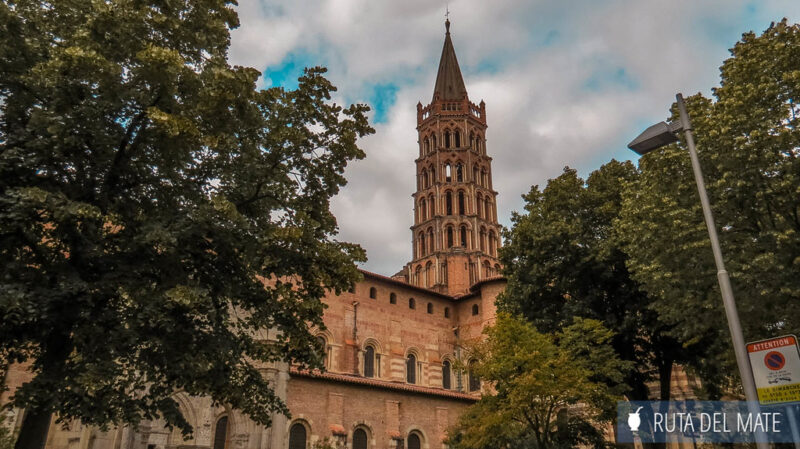
The Basilica of Saint Sernin is a UNESCO World Heritage Site, and part of the French section of the Camino de Santiago.
This 11th-century basilica is dedicated to Saint Saturninus, the first bishop of Toulouse. It stands out for its octagonal bell tower, visible from several points in the city.
Inside, pay special attention to its high altar and crypt, where the relics of Saint Saturninus are preserved.
It has been (and still is) an important stop on the pilgrimage routes to Santiago, especially for those coming from Italy. Admission is free.
4) The Cathedral of Saint Stephen
One of the highlights in Toulouse is the Cathedral of Saint-Étienne, or Saint Stephen’s Cathedral. Construction began in the 13th century on the site where Saint Saturninus supposedly built a chapel. However, the works extended over several centuries, and the cathedral was not completed until the 17th century.
Both the interior and exterior of the cathedral show architectural details from different periods.
Inside, the cathedral is stunning, with high ribbed vaults, slender columns, and beautiful stained glass windows filtering sunlight. Also noteworthy are the carved choir and a monumental organ, one of the largest in France.

5) Convent of the Jacobins
Another must-see attraction in Toulouse is the Convent of the Jacobins. Founded by the Order of Preachers, or Dominicans, the convent was built to serve as the headquarters of the order and as a place of study and prayer. Construction began in 1230 and was completed in the early 14th century.
It consists of a single vaulted nave with pointed arches, a raised choir, and slender columns that resemble a palm tree at the top. At the base of one of the columns, mirrors are placed to give visitors a different perspective of the ceiling.
Inside the church of the Convent of the Jacobins lies the tomb of Saint Thomas Aquinas, one of the most influential theologians of the Catholic Church, making it an important pilgrimage site.
Entrance to the church is free. To access the cloister, the fee is €5 (free for students under 25).

6) Pont Saint Pierre over the Garonne River and La Grave Hospital
The Pont Saint Pierre is one of the main bridges in Toulouse, connecting the historic city center with the Saint Cyprien neighborhood on the other side of the Garonne River. Just across, you’ll find one of Toulouse’s most iconic landmarks, La Grave Hospital with its domed chapel.
📝 The Saint-Joseph de la Grave Chapel can be visited inside and costs about €5 (updated prices for 2025).
Also on this side of the Garonne River is Port Viguerie, a meeting and leisure area that features a large Ferris wheel. If you’re not afraid of heights, we recommend hopping on for beautiful views of the city from above—especially at sunset.


7) Canal du Midi
The Canal du Midi runs through the Toulouse region in southern France. Built in the 17th century, the canal is renowned for its remarkable engineering, earning it recognition as a UNESCO World Heritage Site.
It connects the Garonne River in Toulouse with the Mediterranean Sea near the city of Sète. Its construction was a monumental achievement at the time, as it facilitated the transport of goods and people between the Atlantic and the Mediterranean without having to cross the Bay of Biscay.
Today, the Canal du Midi is a perfect spot to relax and enjoy its tree-lined banks, where you can cycle, hike, or simply enjoy a peaceful boat cruise.
8) Pierre Baudis Japanese Garden
We began our walk along the Canal du Midi and made our way to the Japanese Garden, especially recommended for its quirky or unusual statues.
We wandered through the small Japanese garden, complete with its classic red bridge, paper-walled house, and different native plants. The only odd statue we found was of a dragon—which was a bit strange, but aside from that, the rest of the park is pleasant to stroll through, with play areas for children and plenty of family life.

9) Fun Facts about Toulouse
a) Toulouse’s street signs
Another thing that caught our attention in the city is that the street signs are in two different languages, and even TV programs are broadcast in one language with subtitles in another. These two languages are French and Occitan (similar to Catalan), which corresponds to this historic region of southern France.
b) Gardel was born in Toulouse
A controversial claim, to be fair. Toulouse claims to be the birthplace of Carlos Gardel and highlights this with a dedicated room inside the Capitole, where his portrait is painted on the ceiling, and with the Tangopostal Festival held every July.
True or not, I (Flor) am a frequent user of FamilySearch, a website run by the Catholic Church that hosts hundreds of genealogical trees and scanned records of all kinds. While searching, I came across both the Uruguayan and the French versions of his family tree.
10) Things to do in Toulouse in 2 days or more
As we mentioned at the beginning, Toulouse has a lot to offer, but we’ve already highlighted the most important attractions in this article. If you have more time, we recommend these additional activities:
- Church of Our Lady of the Daurade: Inside you’ll find the image of the Black Madonna, dressed in luxurious garments.
- Augustins Museum: This fine arts museum is housed in a former convent and showcases an impressive collection of European artworks ranging from the Middle Ages to the 20th century. Stroll through its halls and admire masterpieces by artists such as Rubens, Delacroix, and Toulouse-Lautrec.
- Wine tasting in nearby vineyards: Toulouse is surrounded by famous wine regions such as Gaillac, Fronton, and Cahors. Take a day trip to one of these regions and enjoy wine tastings at local vineyards.
- Explore charming nearby towns: Dedicate a day to exploring some of the picturesque towns and cities near Toulouse, such as Albi, Carcassonne, or Auch. If you don’t want to go on your own, here are two great-value tour options:
11) Two Ideas for Visiting Toulouse with Kids
a) Cité de l’Espace (Space City)
Located on the outskirts of Toulouse, this theme park is dedicated to space exploration and astronomy. It features a wide range of attractions and interactive exhibits that provide an immersive experience into the world of space.
Highlights include a 3D planetarium, a full-scale replica of the Apollo 11 lunar module, and a giant telescope for observing the night sky.
If you’re traveling with kids to Toulouse, they’ll love it—not only because of what they can learn, but also because they can take part in fun hands-on activities, such as simulating a rocket launch, experiencing zero gravity on a special trampoline, or building and launching their own water rocket.
Tickets to Cité de l’Espace: Adults €29 / Children 5–18 years €22.50.
Halle de la Machine
Very close to Cité de l’Espace, you’ll find this exhibition hall of giant fantasy-themed automatons. Daily demonstrations showcase how these machines work, and they are guaranteed to amaze the little ones.
Useful Information for Your Trip to Toulouse
Where to Stay in Toulouse?
The area bordered by the river, the Canal du Midi, and Allee Jules Guesde is the best place to stay in Toulouse. The closer you are to Toulouse Matabiau train station, the lower the prices. As you move towards the historic center, prices tend to rise.
Our top recommendations for accommodation in Toulouse are:
- Ibis Toulouse Gare Matabiau, located across from the train station and just a 10-minute walk from the city center. Clean and comfortable rooms. Good value for money.
- Royal Wilson: 500 meters from Capitole Square, housed in an old building with an inner courtyard. Rooms are fairly spacious compared to the French average.
- Hotel Le Père Léon: located in front of Esquirol metro station and surrounded by restaurants. Modern facilities and excellent service.
What you need for your trips to Europe
Plan your journey easily with these trusted resources: